E-LEARNING DEVELOPMENT
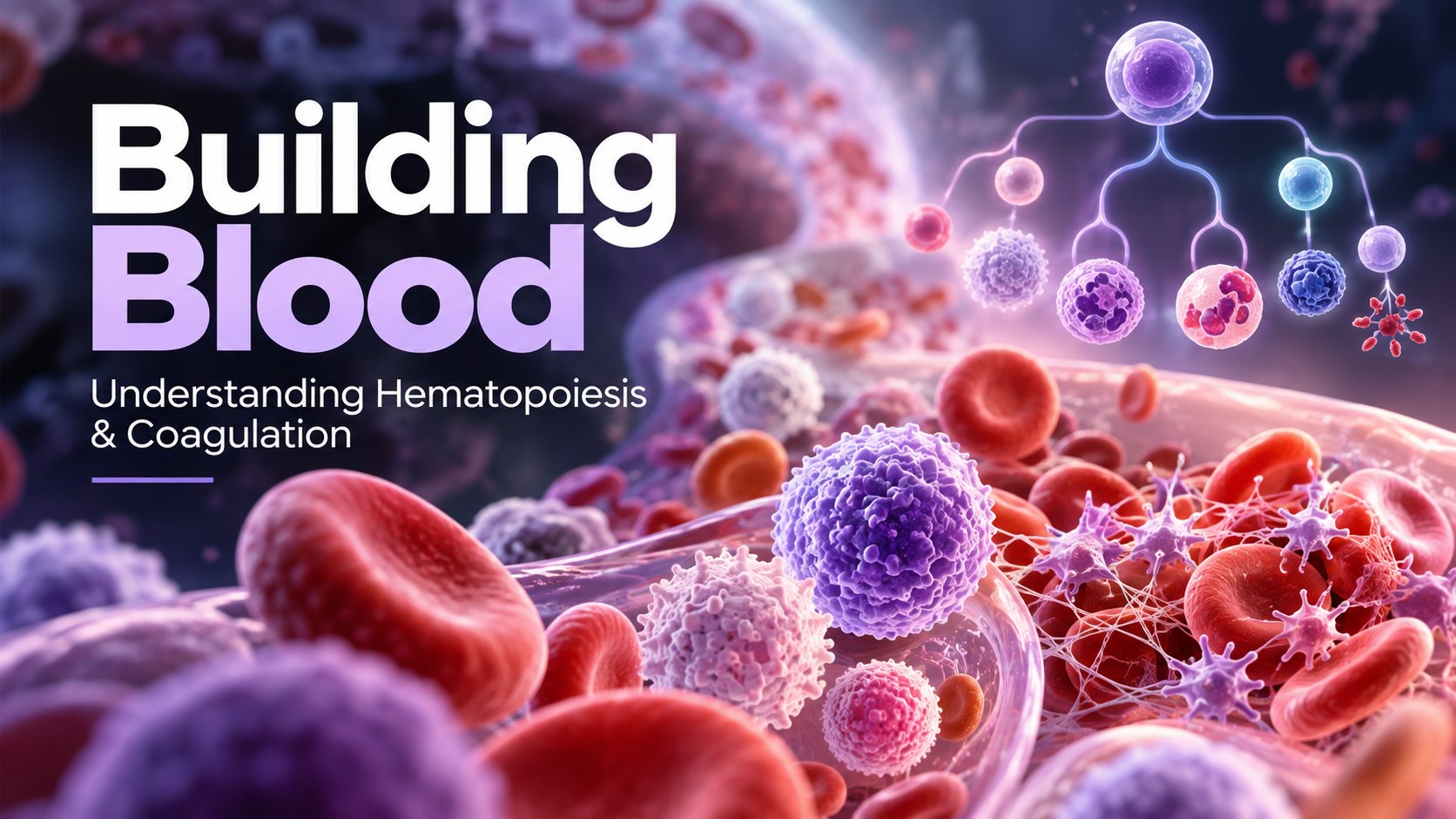
Building Blood: Understanding Hematopoiesis & Coagulation
An interactive medical education experience designed to help learners understand hematopoietic differentiation, distinguish blood-cell lineages, connect cells with their clinical functions, and reinforce key relationships through purposeful interaction and feedback.
THE CHALLENGE
Complex relationships need more than a wall of content.
Building Blood was developed as an interactive online learning experience for a medical education design challenge. The content required learners to understand not only individual blood-cell types, but the relationships among hematopoietic stem cells, differentiation pathways, clinical functions, signaling factors, and related disorders.
The design challenge was to organize those relationships into a learning experience that learners could navigate independently while still requiring them to actively distinguish, connect, and retrieve key concepts.
LEARNING OBJECTIVES
Designing backward from what learners needed to do.
Identify the stages of hematopoietic stem cell differentiation.
Distinguish between myeloid and lymphoid blood cell lineages.
Match blood cell types to their primary clinical functions.
These objectives helped determine which information needed to be presented, which relationships needed to be made visible, and where learners needed opportunities to practice.
MY ROLE
From medical content to learning experience.
- Content analysis and organization
- Instructional strategy
- Learning experience design
- Rise 360 development
- Interaction design
- Knowledge-check development
- Feedback design
- Visual and multimedia integration
- Accessibility and inclusive-design considerations
CONTENT ARCHITECTURE
Following the hematopoietic tree.
Hematopoietic Stem Cell
MYELOID
Common Myeloid Progenitor
- Granulocytes
- Monocytes
- Erythrocytes
- Megakaryocytes , which produce Platelets
LYMPHOID
Common Lymphoid Progenitor
- T Lymphocytes
- B Lymphocytes
- Natural Killer Cells
EXPERIENCE DESIGN
From explore, to sort, to match, to retrieve.
-
Explore
Learners move through interactive components that connect cell types with differentiation signals, clinical roles, and related disorders.
-
Distinguish
The Myeloid or Lymphoid sorting interaction asks learners to classify blood cells according to developmental lineage.
-
Connect
A matching activity requires learners to connect blood-cell types with their primary clinical functions.
-
Retrieve
Knowledge checks require learners to recall differentiation signals, functions, and lineage relationships.
-
Learn from Feedback
Answer-specific explanations reinforce why responses are correct or incorrect and clarify relationships among concepts.
INTERACTION SPOTLIGHT
Myeloid or Lymphoid?
After exploring the two primary differentiation branches, learners are asked to sort individual blood-cell types into their correct developmental lineage.
This changes the learner's task from reviewing the information to actively discriminating between the two pathways.
Cards to sort
- Neutrophils
- T Lymphocytes
- Eosinophils
- B Lymphocytes
- Basophils
- Monocytes
- Erythrocytes
- Platelets
- Natural Killer Cells
FEEDBACK DESIGN
A wrong answer can still move learning forward.
The course's knowledge checks include explanatory feedback designed to reinforce relationships and address misconceptions. Instead of only marking a response right or wrong, feedback explains the role of the option the learner chose.
One question asks which signal guides differentiation into megakaryocytes. Its options are Stem Cell Factor, G-CSF, IL-7, and Thrombopoietin, and each distractor belongs to a different part of the hematopoietic story.
-
Learner selects
G-CSF
as the signal for megakaryocyte differentiation
-
Feedback clarifies
G-CSF supports granulocyte differentiation
explaining where the distractor actually belongs
-
Learner can better
distinguish granulocyte and megakaryocyte signaling
The assessment becomes another learning opportunity rather than simply a checkpoint.
MULTIMEDIA
Making an invisible process easier to see.
Hematopoiesis happens at a scale learners cannot observe directly. The learning experience used visual representations alongside the text so learners could see relationships that are hard to picture from terminology alone.
Course imagery and blood-cell video worked with structured content and interaction, giving learners more than one way to take in the same idea.
-
Hematopoietic stem-cell development
Showing the starting point of the journey that every other cell in the course traces back to.
-
Common Myeloid Progenitor pathways
Picturing the myeloid branch and the cells that develop from it.
-
Common Lymphoid Progenitor pathways
Picturing the lymphoid branch as a distinct path from the myeloid line.
-
Blood-cell differentiation
Making the movement from progenitor to mature cell easier to follow.
-
Clinical roles and related concepts
Connecting what each cell looks like and where it comes from to what it does.
ACCESSIBILITY & INCLUSIVE DESIGN
Supporting clarity, navigation, and learner control.
The design was informed by Universal Design for Learning principles, particularly the value of clear structure, multiple forms of representation, and active learner engagement.
- Clearly chunked content
- Consistent navigation
- Learner-controlled pacing
- Multiple forms of representation
- Visual support for complex concepts
- Meaningful feedback
- Alt-text considerations
- Captioning considerations for multimedia
- Inclusive imagery where appropriate
THE SOLUTION
Explore Building Blood.
The finished Rise 360 experience combines structured medical content, interactive exploration, classification, matching, knowledge checks, multimedia, and explanatory feedback in a self-paced learning experience.
Launch Learning Experience (opens in a new tab)Built with Articulate Rise 360
REFLECTION
Design the relationships, not just the screens.
Building Blood reinforced the importance of identifying the relationships learners need to understand before deciding how the content should appear on screen.
The hematopoietic tree naturally contains a large amount of terminology, but knowing individual terms is different from understanding how stem cells differentiate, how lineages relate, and how those cells function clinically.
The strongest design decisions in this project came from turning those relationships into learner actions: explore the pathways, distinguish the lineages, match cells to functions, retrieve key information, and learn from feedback.
For me, this project demonstrates that interaction is most useful when it asks learners to do something meaningful with the content, not simply click through it.